The National Autism Association -
Northeast Ohio (NAA-NEO) Presents
2nd Annual Autism Concert
to Benefit Northeast Ohio Families and the Helping Hand
Program
In response to the overwhelming amount of grant requests
for the National Autism Association - Northeast Ohio (NAA-NEO)
Helping Hand grant program, two benefit concerts will be
held in February 2008. The goal of these events is to
raise the necessary funds so that we can respond to the
high need for funding autism treatments and therapies in
the Northeast Ohio community.
Two shows will be staged this time - one in Akron, OH
and one in Cleveland so that we can reach two major
Northeast Ohio audiences. Support our mission by joining
us at either of these events!
Click here for details!
NAA Joins Sponsor Little
Playdates at the Golden Globes "Boom Boom Room"

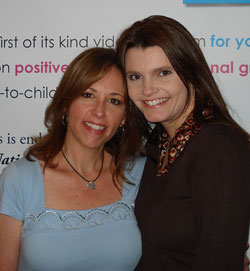
NAA President Wendy
Fournier with Little Playdates CEO JoAnne Pettry
Little Playdates, a dedicated supporter of the
National Autism Association, was recently invited to
distribute their award-winning children's videos at The
Boom Boom Room - a Golden Globes gifting suite for
celebrities and their children in Los Angeles. The
company's founders, Trent and JoAnne Pettry invited NAA
president Wendy Fournier to join them at this exciting
event.
Celebrities in attendance included Chandra Wilson of
Grey's Anatomy, Jodie Sweetin of Full House, Singer
Carnie Wilson, Dayna Devon, host of EXTRA TV, Denise
Richards of Spin City, Tracey Gold of Growing Pains,
Rena Sofer of Heroes, Chris Noth of Sex and the City,
Lisa Rinna, Ali Landry, Scott Baio, Tori Spelling, Jason
Priestly and many more!
Our
sincere thanks to JoAnne and Trent for their ongoing
support and for providing this wonderful opportunity to
bring awareness to the needs of our children and the
mission of the National Autism Association.
Beginning next month, the Little Playdates video series
for children will be distributed to retail stores across
the country by PorchLight Entertainment. Each
video includes a public service announcement on the
warning signs of autism produced by NAA co-founder Lori
McIlwain with her husband Christian. The PSA can
be viewed online here:
https://www.nationalautismassociation.org/images/NAA%20QT1.mov

You can help raise
money for NAA's Research and Family Care Programs just
by searching the web! Each time you use the
GoodSearch search engine at
http://www.goodsearch.com NAA will receive a penny!
Just go to GoodSearch and choose NAA as your charity to
support!
NAA's
Faces of Autism 2008 Calendar Now Only $8!

Our 2008 calendar featuring
the winners of our annual photo contest is
now available in our online store. Thank you
to the hundreds of parents who submitted
photographs and shared the beauty of their
children with us.
With each
month that passes, a new face of hope will
emerge. The Faces of Autism calendar
spawns a sort of inner hope that could only
come from the eyes and the smiles of the
children we call our own. Twelve
different faces, our favorite sponsors and
inspiring messages on each page make this
the calendar specially designed for the
autism community. Proceeds benefit
autism research, advocacy and family care
programs through NAA. Order yours
today as a gift for yourself or someone you
love. Just
click here, and thank you for your
continued support.
https://www.nationalautismassociation.org/proddetail.php?prod=2008Calendar
ABC Drama Takes on Science
and Parents
By EDWARD WYATT
New York Times
http://www.nytimes.com/2008/01/23/arts/television/23ston.html?_r=1&oref=slogin
LOS ANGELES — A new legal drama making its debut this
month on ABC is stepping into a subject that is the
source of heated debate among some parents — the
relationship between autism and childhood vaccines — and
seemingly coming down on the side that has been all but
dismissed by prominent scientific organizations.
The drama, “Eli
Stone,” scheduled to be broadcast at 10 p.m. on Jan. 31,
centers on a lawyer who begins having visions that cause
him to question his life’s work defending large
corporations, including a pharmaceutical company that
makes vaccines.
The title character
of “Eli Stone,” adopting the message of his visions to
fight for the little guy, takes his first case: suing
his former client on behalf of the mother of an autistic
child who believes a mercury-based preservative in a
vaccine caused her son’s autism.
For the last decade
some parents and advocates for autistic children have
championed the theory that a mercury-based vaccine
preservative called thimerosal, developed in the late
1920s and used in many childhood vaccines until about
seven years ago, is a primary cause of autism in young
children.
Autism often is
diagnosed in children between their first and fourth
years, during the time that many children begin
receiving regular rounds of vaccinations.
But reams of
scientific studies by the leading American health
authorities have failed to establish a causal link
between the preservative and autism. Since the
preservative was largely removed from childhood vaccines
in 2001, autism rates have not declined.
While police and
legal dramas often use ripped-from-the-headlines topics
as the basis of episodes, rarely do broadcast networks
allow themselves to stray into the middle of heated
debates that contain such emotional touchstones for
large segments of their audience, if only because
another big segment of a network’s audience is likely to
be on the other side of the debate.
With “Eli Stone,”
however, neither ABC nor its ABC Studios production unit
has expressed any qualms about the story, according to
Greg Berlanti, a co-creator and an executive producer of
the series, who said he believed that the script showed
both sides of the argument. “I think they wanted us to
do our homework about all of it, which we did,” he said.
But the script also
takes several liberties that could leave viewers
believing that the debate over thimerosal — which in the
program’s script is given the fictional name mercuritol
— is far from scientifically settled.
Through a
spokeswoman, ABC declined to offer an executive to
discuss the show.
The issue is a
potentially delicate one for ABC. Eli Lilly & Company,
which developed thimerosal, and the two companies that
now make the bulk of childhood vaccines used in the
United States, GlaxoSmithKline and Sanofi-Aventis, spent
an estimated $138 million for advertising on ABC last
year, according to Nielsen Monitor-Plus, though little
to none of it was spent advertising vaccines.
Representatives of
all three companies expressed dismay about the series,
of which they said they were unaware until called by a
reporter.
Nancy Pekarek, a
spokeswoman for GlaxoSmithKline, said the episode raised
public-health concerns. “If parents watching this
fictional series make that incorrect conclusion about a
link” between vaccines and autism “and as a result
choose not to vaccinate their own children, the
consequences could be devastating,” she said.
Doctors have
previously expressed fears that the popularity of the
antivaccine movement could have adverse effects. In
Britain a widely publicized — and since discredited —
research paper published in 1998 started a scare over
the safety of the vaccine for measles, mumps and
rubella, drawing a potential link to autism. Though the
premise of the research did not concern thimerosal,
vaccination rates plunged in Britain. Over the next two
to six years, outbreaks of measles soared in Britain and
Ireland, causing at least three deaths and hundreds of
children to be hospitalized.
Among the
organizations that have studied possible links between
autism and the preservative in vaccines are the Centers
for Disease Control and Prevention, the Food and Drug
Administration, the Institute of Medicine, the World
Health Organization and the American Academy of
Pediatrics. Each of them has largely dismissed the idea
that thimerosal causes or contributes to autism, and
five major studies have found no link.
Since 2001, no
vaccine routinely administered to children in the United
States had more than half a microgram of mercury, about
the amount found in an infant’s daily supply of breast
milk.
But plenty of
parents, as well as groups like SafeMinds, continue to
say that a link exists. “We feel it is still an open
question,” said Theresa Wrangham, president of SafeMinds,
a nonprofit parent organization. Their position has been
supported in recent years by some members of Congress
and by public advocates including Robert F. Kennedy Jr.
The initial episode
of "Eli Stone" posits that the child received a flu
vaccine containing the preservative; in recent years
vaccine makers have produced new versions of the flu
vaccine for children that do not contain the
mercury-based preservative.
“Is there proof that
mercuritol causes autism?,” Eli Stone says to the jury
in summing up his lawsuit against the vaccine maker.
“Yes,” he says. “Is that proof direct or
incontrovertible proof? No. But ask yourself if you’ve
ever believed in anything or anyone without absolute
proof.”
The script also draws
a parallel with research linking smoking and cancer,
saying three decades passed between the first lawsuit
charging a connection and the first jury award against a
tobacco company. After the dramatic courtroom revelation
that the chief executive of the vaccine maker did not
allow his daughter’s pediatrician to give her the
company’s vaccine, the jury in “Eli Stone” awards the
mother $5.2 million. (In each episode Eli Stone takes on
a different cause; in other episodes sent to television
reviewers for preview, he wages court battles against a
pesticide maker and a priest.)
In the last two years
Mr. Berlanti, who created “Eli Stone” with Marc
Guggenheim, has become a major contributor to ABC’s
primetime lineup. He also is an executive producer of
“Brother & Sisters” and “Dirty Sexy Money.” Mr.
Guggenheim is a lawyer who has worked on several
law-related series, including “The Practice” and “Law &
Order.”
In interviews both
men said they did not have any personal ties to the
subject of autism and childhood vaccines. Mr.
Guggenheim, who has two young children, said he had
questioned his pediatrician about the number of vaccines
his children were receiving. “I haven’t vaccinated them
as aggressively as I could,” he said.
Both of the producers
also said that they wanted “Eli Stone” to provoke
conversation.
“A lot of TV these
days is not talking about the same things that the
nightly news is talking about,” Mr. Berlanti said. “As a
show, we want to keep the conversation going after
people turn off the television.”